
The role of the COYAC is to:
- Advise state legislators on issues most relevant to youth
- Build relationships between youth and elected leaders
- Develop policy recommendations for legislators
- Educate students about the critical skills of civil discourse and provide them with opportunities to practice
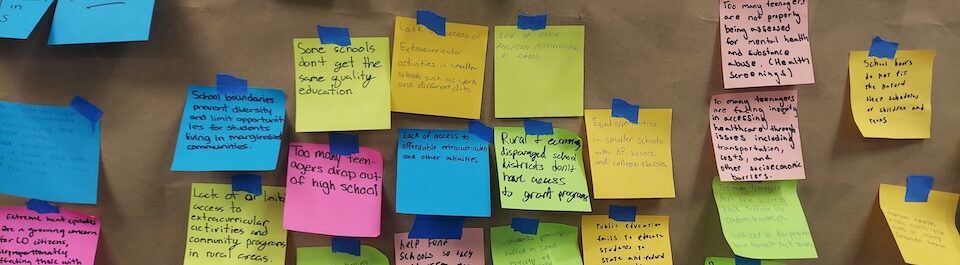
Each year, the COYAC teens choose policy priorities to examine, evaluate, and recommend. At the two-day retreat in August, students discuss dozens of problems they experience as teenagers and divide themselves into policy committees. Committees meet weekly, virtually, and spend months conducting research and outreach. The policy memos (linked below) they submit each June are the students’ own viewpoints, research, outreach, and writing.
COYAC’s contracted staff is nonpartisan and policy agnostic. Staff supports the students similarly to the way Legislative Council staff supports the state legislators, providing training on government 101, planning, and logistics.
2025-2026 Policy Committees
On July 31, 2026, at 9 a.m. we’ll present our recommendations (COYAC Policy Recommendations 2025-26.pdf) to the legislature’s Representative Hugh McKean and Senator Faith Winter Colorado Youth Advisory Council Review Committee. Listen here (live or recorded)
View the Current Pending Proposals TrackerPolicy Recommendations
On July 15, 2025, COYAC members presented their policy recommendations to the legislators of the Colorado Youth Advisory Council Committee; this committee no longer has the authority to recommend legislation through the interim committee process (SB25-199). Listen live or to recordings of the meeting.
This year, COYAC members formed six policy committees and wrote 11 policy recommendations: COYAC 2024-25 Policy Recommendations (PDF)
- Education: Access to preparation materials for SAT, ACT, and AP Tests; Funding for civic education programs
- Environmental: Pollution from plastic waste, air quality issues, and water contamination; Unequal enforcement of environmental mandates
- Healthcare: Inform and mobilize youth about public health and environmental hazards; Access to equitable healthcare and medical options in rural areas
- Postsecondary education planning resources: Resource gaps for young adults with intellectual disabilities to transition into postsecondary institutions; Independent living skills for young adults; Statewide platform for Individual Career and Academic Plans (ICAP)
- Substance abuse: Promoting the Colorado QuitLine; Nicotine labeling; Collecting and reporting data about oral nicotine pouch use
- Teacher retention: Addressing Colorado’s teacher shortage
On August 1, August 15, and October 1, 2024, COYAC members met with the legislators of the Colorado Youth Advisory Council Committee to present and discuss the students’ policy proposals. (Listen live or to recordings of the meetings.) The legislators could recommend up to six proposals to become draft bills with fiscal notes and could refer up to three bills for introduction at the 2025 legislative session. The 2023-24 COYAC cohort created eight policy proposals:
- Increasing Accessibility in School Buildings inspired the sponsor of HB25-1030 Accessibility Standards in Building Codes to include schools in the bill, which became law
- Increasing Health Literacy for Youth
- Piloting Innovative Options for School Transportation
- Funding Solar Panels for Schools
- Adding Youth Representatives to the Environmental Justice Advisory Board inspired SB25-055 Youth Involvement in Environmental Justice, which became law
- Educating Youth on the Transition to Renewable Energy
- Reducing Food Waste in Schools inspired HB25-1059 Food Waste Reduction in Public Schools, which became law
- Distributing Naloxone to Prevent Overdoses inspired SB25-164 Opioid Antagonist Availability & State Board of Health, which became law
On August 9, August 17, and October 25, 2023, COYAC members met with the legislators of the Colorado Youth Advisory Council Committee to present and discuss the student’s policy proposals. (Listen live or to recordings of the meetings.) The legislators could recommend up to six proposals to become draft bills with fiscal notes and could refer up to three bills for introduction at the 2024 legislative session. The 2022-23 COYAC cohort created six policy proposals:
- Youth Mental Health: Efforts to Increase the Number of Licensed Psychologists for Youth inspired HB24-1049 School Mental Health Professionals Loan Repayment Program
- Violence Against Youth: Prevention, Intervention, and Response in Colorado Schools inspired HB25-1250 Gun Violence Prevention & Parents of Students, which became law
- Asian-American History: Diversity & Representation in Education
- Resource Assistance in Public Schools inspired HB24-1164 Free Menstrual Products to Students, which became law
- Non-Legal Name Changes in Schools for Youth Ages 12-17 inspired HB24-1039 Non-Legal Name Changes, which became law
- Youth Gender-Affirming Care: Ensuring Widespread Provider Training and Knowledge inspired HB24-1040 Gender-Affirming Health-Care Provider Study, and legislators funded the idea in another bill
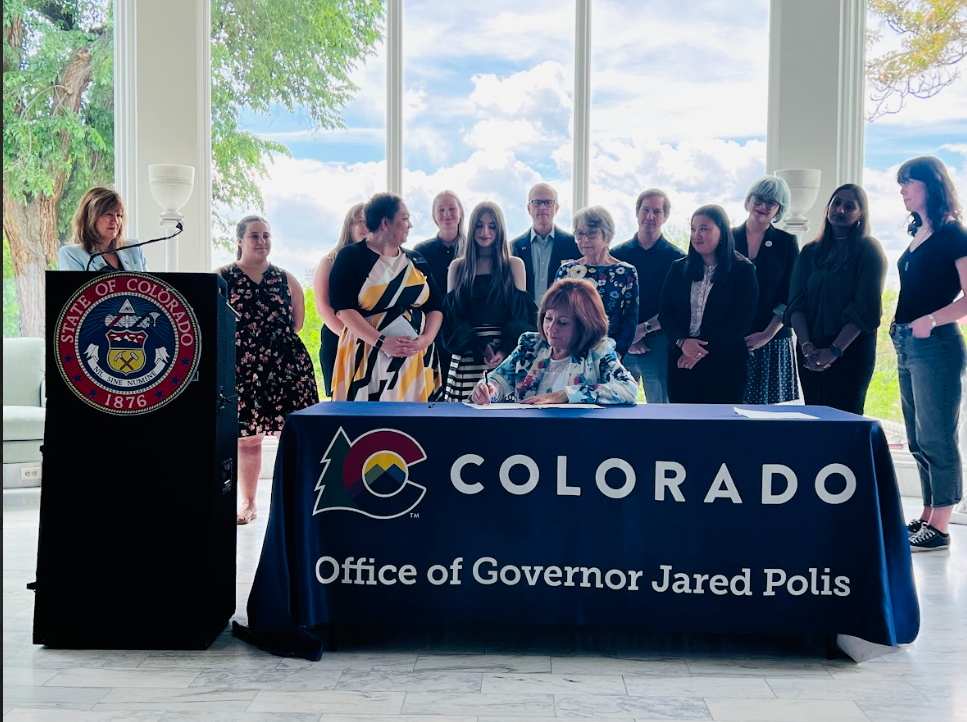
On August 5, August 19, and September 30, 2022, COYAC members met with the legislators of the legislators of the 2022 Colorado Youth Advisory Council Review Committee . The legislators could recommend up to six proposals to become draft bills with fiscal notes and could refer up to three bills for introduction at the 2023 legislative session. The 2021-22 COYAC members presented seven policy proposals:
- Disciplinary Equity in Education: Co-Creation and Accountability in Restorative Planning inspired SB23-029 Disproportionate Discipline In Public Schools, which became law
- Increasing Completion of Financial Aid Applications is similar to HB25-1192 Financial Literacy Graduation Requirement, which became law
- Increasing the Number of Licensed Psychologists for Youth
- Reforming Intervention Response to Substance Abuse in Secondary Schools inspired HB23-1009 Secondary School Student Substance Use, which became law
- Youth Participation in Updating Educational Standards inspired SB23-008 Youth Involvement Education Standards Review, which became law
- Youth Public Health: Eating Disorders and Weight Discrimination inspired SB23-014 Disordered Eating Prevention, which became law
- Youth Sexual Health: HIV Education and Prevention

On August 16 and September 3, 2021, COYAC members presented three policy proposals at the legislature’s Colorado Youth Advisory Council Review Committee. The legislators on the committee recommended all three proposals to become draft bills with fiscal notes.
In April 2019, COYAC members presented three policy proposals to the legislature’s Colorado Youth Advisory Council Review Committee. Youth Budget, Youth Impact Statement, and Youth Advisory Committee Review.
COYAC 2017 – 2018 Policy Recommendations (PDF) – Teacher Based Mental Health Training, Youth Substance Use, and K-12 Funding
COYAC 2016 – 2017 Policy Recommendations (PDF) – Youth Mental Health Awareness and Suicide Prevention, Education and Technology, Secondary Education/Individual Career and Academic Plan Review, and Teen Homelessness
COYAC 2015 – 2016 Policy Recommendations (PDF) – 21st Century Learning, Teen Drug and Alcohol Abuse, Issues of Underrepresented Populations in Colorado (refugee/LGBTQ+), and Access to Mental Health Services
COYAC 2014 – 2015 Policy Recommendations (PDF) – K12 Standardized Testing, Behavioral Health, Public Safety: Includes School Safety & Human Trafficking, Water
COYAC 2013 – 2014 Policy Recommendations (PDF) – Narrowing the Achievement Gap, Exploring Jobs and Higher Education Opportunities, The Future of Energy Development, Access to Behavioral Health Care (Includes Mental Health Access and Drug and Alcohol Prevention)